
SAP Logistics Management: The SaaS WMS and TMS
Available since February 2026, SAP Logistics Management (SAP LGM) combines warehouse management and transportation execution into a single SaaS solution connected to SAP S/4HANA.
- Integrated Warehousing and Transportation
- Rapid SaaS Deployment
The Benefits of SAP Logistics Management for Your Logistics Sites
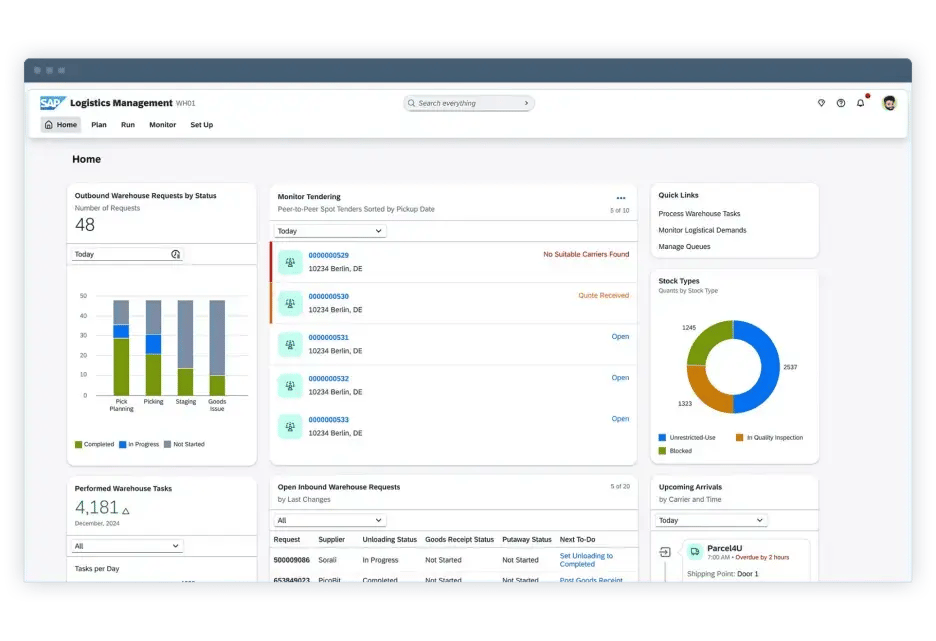
SAP LGM brings features once reserved for large distribution centers to operations of low to medium complexity: real-time visibility, guided processes, and native integration with the ERP system—without the complexity of an EWM or TM project.
Warehousing and transportation on a single platform
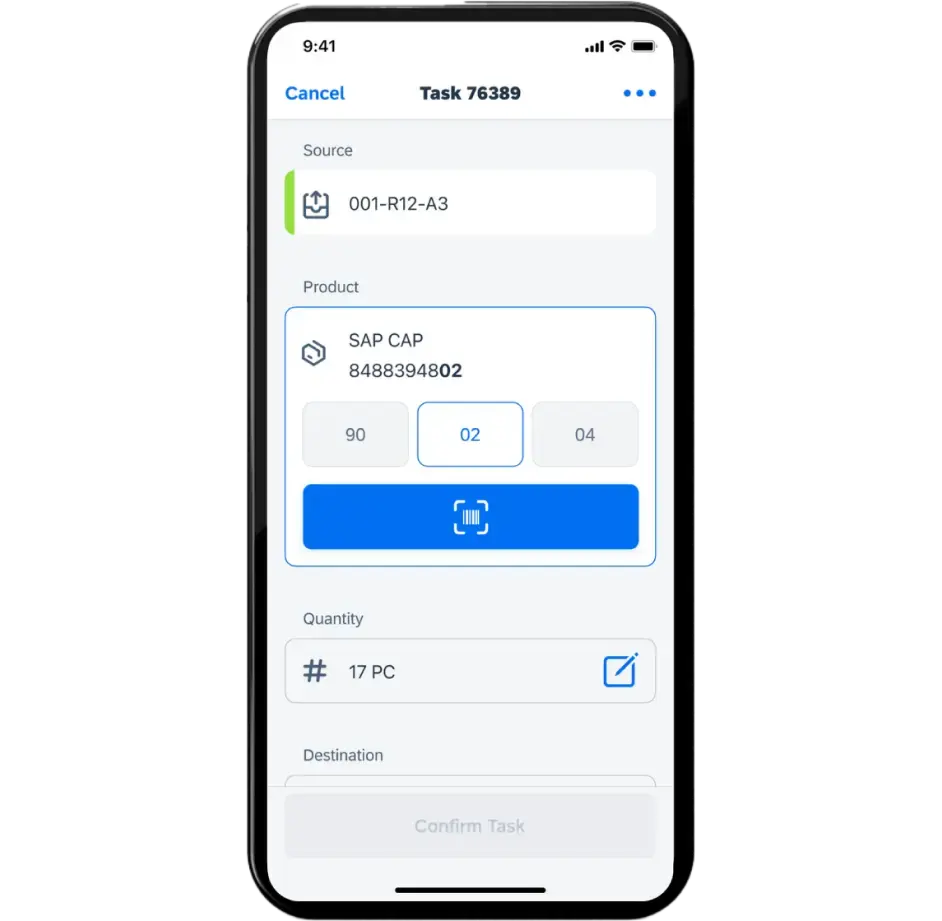
Receiving, putaway, picking, packing, and shipping, followed by transportation planning and tracking: the entire pick-pack-ship workflow is managed within the same tool, using the SAP Warehouse Logistics mobile app for operators.
Rapid SaaS deployment
As a cloud-native solution based on SAP BTP, SAP LGM can be implemented in a matter of weeks rather than several months. New features are delivered with SAP updates, without the need for a version upgrade project.
Native integration with SAP S/4HANA
SAP LGM is designed for SAP S/4HANA. Orders, shipments, and inventory are synchronized without the need to develop and maintain specific interfaces.
Integrated Carrier Collaboration
With the SAP Business Network for Logistics, your carriers receive requests and share updates in real time. Scheduling dock appointments and tracking shipments in transit reduce delays and the need for re-entry.
Joule AI: Supporting Operators
Prepare for automation and implement mobile solutions tailored to on-site conditions to gradually modernize your warehouses.



SAP LGM or SAP EWM and SAP TM: Which Approach Is Right for Your Logistics?
SAP Logistics Management combines warehouse and transportation management into a single tool. For more advanced needs, SAP offers two specialized solutions: SAP EWM for the warehouse and SAP TM for transportation. SAP LGM complements these solutions; it does not replace them.
- Warehouse side —SAP LGM for manual or minimally automated sites with standard processes. SAP EWM for large distribution centers and automated warehouses (conveyors, shuttles, robotics).
- Transportation – SAP LGM for shipping, carrier assignment, and delivery tracking. SAP TM for planning and optimizing complex transportation networks.
- Deployment – SAP LGM as SaaS, in just a few weeks. SAP EWM and SAP TM as part of more comprehensive S/4HANA projects.
In a multi-site network, a common configuration combines SAP EWM in the central warehouse, SAP LGM at satellite sites, and SAP TM for transportation planning.
A solution integrated into your SAP landscape

Integration with SAP S/4HANA
SAP LGM is connected to SAP S/4HANA, which remains the central management system. Master data, documents, and inventory movements are exchanged via standard int...

Coexistence with SAP EWM
SAP LGM and SAP EWM complement each other in a multi-tier logistics architecture.
- SAP EWM for central, highly automated distribution centers <...
Integration with SAP S/4HANA
SAP LGM is connected to SAP S/4HANA, which remains the central management system. Master data, documents, and inventory movements are exchanged via standard interfaces.
- Master data, documents, and inventory are managed centrally in S/4HANA
- Warehouse management and transportation execution in SAP LGM
- Accounting and management accounting maintained in S/4HANA
Coexistence with SAP EWM
SAP LGM and SAP EWM complement each other in a multi-tier logistics architecture.
- SAP EWM for central, highly automated distribution centers
- SAP LGM for regional warehouses, distribution centers, and production supply warehouses
- Inventory synchronization and transportation coordination across sites
In what situations is SAP Logistics Management appropriate?

Small and medium-sized businesses, mid-sized companies, and subsidiaries with standard logistics needs
Companies on S/4HANA that want to unify warehousing and transportation without the complexity of a traditional EWM/TM project, with a rapid SaaS deployment.

Technical stores, spare parts, and samples
Maintenance inventory, spare parts, and samples require precise tracking but do not warrant an EWM project. The Doehler Group has therefore announced that it wi...

Regional and satellite sites in a multi-site network
Your central warehouse runs on SAP EWM, but your regional warehouses and satellite locations do not have a WMS. SAP LGM quickly equips them with bin management ...

Seasonal Activities and Temporary Sites
Whether it's peak activity, overflow warehouses, or sites opened for a project: in SaaS mode, SAP LGM can be set up quickly and scales with rising or falling vo...

Integration with SAP IM, Stock Room Management, or third-party solutions
Secondary sites still managed using SAP IM or Stock Room Management (with SAP providing maintenance only, without new features), or third-party WMS/TMS systems ...
Technical stores, spare parts, and samples
Maintenance inventory, spare parts, and samples require precise tracking but do not warrant an EWM project. The Doehler Group has therefore announced that it will deploy SAP LGM at more than 50 production sites for these purposes.
Regional and satellite sites in a multi-site network
Your central warehouse runs on SAP EWM, but your regional warehouses and satellite locations do not have a WMS. SAP LGM quickly equips them with bin management and shared visibility into inventory across the network.
Seasonal Activities and Temporary Sites
Whether it's peak activity, overflow warehouses, or sites opened for a project: in SaaS mode, SAP LGM can be set up quickly and scales with rising or falling volumes.
Integration with SAP IM, Stock Room Management, or third-party solutions
Secondary sites still managed using SAP IM or Stock Room Management (with SAP providing maintenance only, without new features), or third-party WMS/TMS systems with costly interfaces: SAP LGM provides physical location management, guided picking, and carrier collaboration within the SAP environment.
Modernize Your Logistics with SAP Logistics Management
- Integrated Warehousing and Transportation
- Rapid SaaS Deployment
- Native S/4HANA Integration
