
Background: Why SAP LGM Was Introduced
Since the introduction of SAP S/4HANA, companies have had a clear framework for managing their warehouses: SAP IM for basic inventory management, SAP EWM (Basic or Advanced) for warehouse operations, and SAP TM for transportation. This trio covers virtually all logistics needs.
However, there was still a blind spot: sites with low or moderate complexity (satellite warehouses, regional sites, spare parts warehouses, production depots) for which SAP EWM was perceived as too cumbersome to deploy, too costly to maintain, and whose users often reverted to SAP IM or third-party solutions.
It is precisely this gap that SAP has decided to fill by launching SAP Logistics Management, officially announced on October 7, 2025, at SAP Connect (Las Vegas) and available in Q1 2026.
What is SAP Logistics Management?
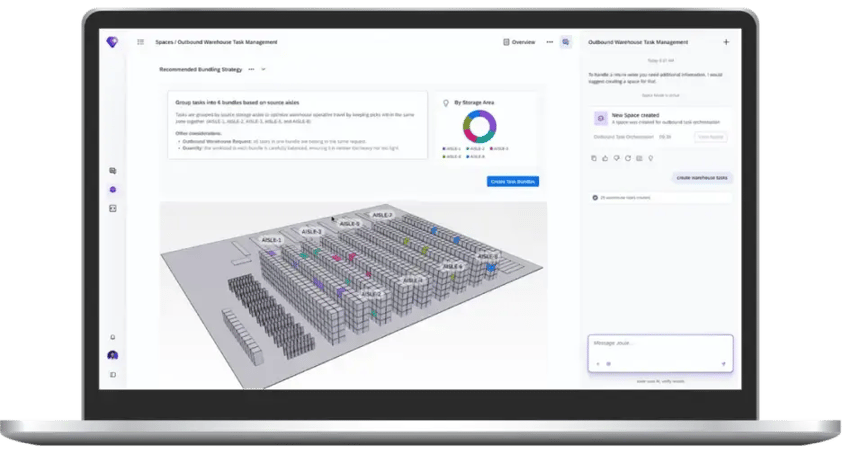
SAP Logistics Management (SAP LGM) is a native SaaS solution built on the SAP Business Technology Platform (BTP). It brings together warehouse execution and transportation management capabilities into a single tool, with native integration with SAP S/4HANA Cloud Private Edition and the SAP Business Network for Logistics.
In summary, SAP LGM addresses three logistics dimensions within a single platform:
- Warehouse management: receiving, putaway, picking, shipping, location and inventory management.
- Transportation management: shipment planning, delivery tracking, and collaboration with carriers.
- Network collaboration: direct connection to partners, carriers, and service providers via the SAP Business Network.
AI is at the heart of the solution: Joule, SAP’s AI assistant, is natively integrated to provide recommendations in natural language, detect inventory anomalies, guide operators, and automate routine tasks.
Position within the SAP ecosystem: a complement, not a competitor
It is essential not to confuse SAP LGM with SAP EWM or SAP TM. SAP made this clear at the launch: this solution complements existing solutions—it is not a replacement.
|
Criterion |
SAP LGM |
SAP EWM + TM |
|---|---|---|
|
Target |
Low- to moderate-complexity sites, satellite warehouses |
Large distribution centers, complex operations |
|
Deployment |
Native SaaS, rapid (weeks) |
On-premises or private cloud, large-scale project (months) |
|
Processes Covered |
Unified warehouse and transportation operations |
Advanced WMS + Advanced TMS separately |
|
Automation |
Basic to moderate |
High (MFS, robotics, conveyors) |
|
AI integration |
Native Joule (NLP, alerts, recommendations) |
Embedded AI (Labor Planning, Optimization) |
|
License |
New dedicated SaaS offering |
Included in S/4HANA (Basic) or a dedicated license (Advanced) |
SAP’s approach is that of a two-tier network: large central warehouses remain on SAP EWM Advanced, while peripheral nodes in the distribution network can now be equipped with SAP LGM, with seamless integration between the two tiers.
How SAP LGM Differs from SAP IM and SAP WM
For companies still using SAP IM at their secondary sites, SAP LGM represents a true functional breakthrough:
- Physical management of storage locations, loading docks, and material flows—all of which isn't possible in SAP IM.
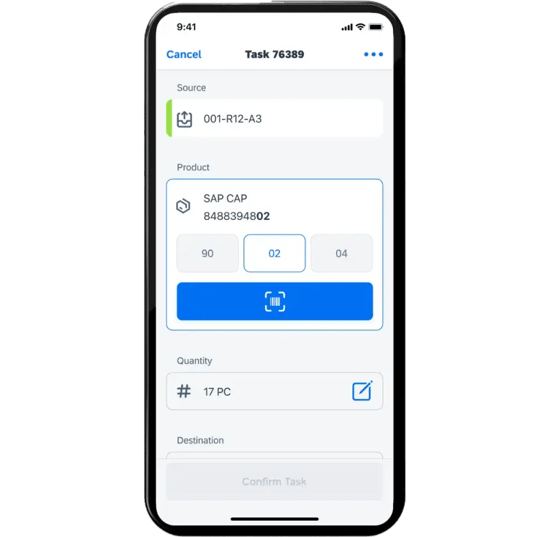
- Orchestration of picking and guided receiving tasks.
- Real-time visibility into inventory and shipments.
- Direct collaboration with carriers without the need for custom development.
Compared to SAP Stock Room Management, SAP LGM goes much further by natively integrating transportation and network collaboration, while also being a fully cloud-based solution with an active roadmap—unlike Stock Room Management, in which SAP is no longer investing.
It is therefore not a matter of extending the existing system, but rather of adopting an integrated logistics execution approach for sites that did not warrant an SAP EWM project.
For which use cases is SAP LGM relevant?
According to SAP’s official positioning and initial feedback from the field, SAP LGM is particularly well-suited for the following configurations:
1. Multi-site networks with satellite nodes
A manufacturer operating a large central warehouse on SAP EWM Advanced and about twenty regional warehouses without a dedicated WMS. SAP LGM enables these warehouses to be quickly equipped with native integration into the central system.
2. Industrial sites with inventories of spare parts or samples
Technical supply rooms, spare parts inventories, or sample warehouses that require location management and shipment tracking, without justifying a full EWM deployment. SAP customer Doehler confirmed this during the announcement regarding its more than 50 production sites.
3. SMEs and mid-market companies with structured logistics needs
Companies running SAP S/4HANA Cloud Private Edition that want to unify their warehouse and transportation management without the complexity of a traditional EWM/TM project.
4. Replacement of fragmented third-party solutions
Organizations using third-party WMS or TMS systems at their secondary sites—with complex interfaces and limited visibility—that want to simplify their logistics architecture.
Key Considerations Before Choosing SAP LGM
SAP LGM is a promising solution, but it is still in its early stages. A few factors warrant special attention before making any implementation decision:
- Functional maturity —Solution launched in 2026: Advanced features (wave management, automated system integration, labor management) are not part of the initial scope.
- SaaS Constraint: As a cloud-native solution, SAP LGM follows the pace of SAP updates. Companies with highly specific processes will need to verify compatibility with their customization needs.
- Compatibility: SAP LGM is currently announced for SAP S/4HANA Cloud Private Edition. Compatibility with on-premise versions is subject to confirmation based on your release.
-
EWM/LGM Coexistence: Managing the coexistence between SAP LGM (satellite sites) and SAP EWM (central warehouse) must be planned for from the very beginning of the architecture design.
Our Opinion at HRC Consulting
SAP Logistics Management is good news for the SAP ecosystem. It fills a real gap and will enable many companies to raise the level of logistics maturity at their secondary sites without committing to a full-scale EWM project.
That said, we must not fall into the opposite trap: SAP LGM is not a substitute for SAP EWM when it comes to highly complex warehouse operations, automated environments, or sites with advanced regulatory traceability requirements. For these scenarios, SAP EWM remains the undisputed standard.
The true value of SAP LGM lies in its architecture: it enables the creation of cohesive logistics networks, where each node has a solution tailored to its complexity, while maintaining end-to-end visibility and integration.