
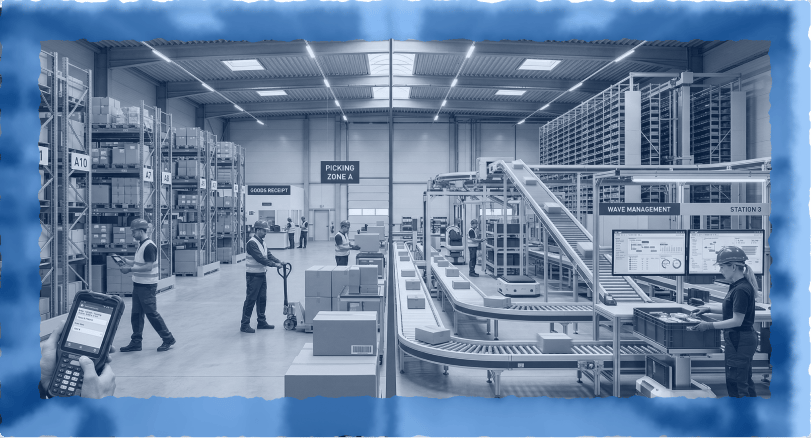
SAP Extended Warehouse Management is SAP’s strategic warehouse management solution within S/4HANA.
It is available in two versions:
- SAP EWM Basic
- SAP EWM Advanced
The choice between these two versions is not driven by volume or the number of operators, but by functional requirements and the level of orchestration needed.
SAP EWM Basic: true warehouse execution, now simplified
SAP EWM Basic introduces a genuine warehouse execution layer within S/4HANA.
It is included in S/4HANA licenses, enabling all sites to benefit from warehouse execution capabilities without additional licensing costs.
Recent evolutions to consider
Recent S/4HANA releases have significantly simplified EWM Basic implementations through:
- Stronger standard integrations with TM, QM, and PP
- Support for synchronous goods movements
- Improved automation of standard warehouse operations
A common misconception persists: EWM Basic is often seen as suitable only for small warehouses or low volumes. In reality, SAP EWM Basic can handle high volumes effectively, the true decision criterion is functional scope.
Advanced capabilities can be activated site by site, enabling a progressive and scalable rollout.
SAP has also expanded its catalog of standard APIs, available in both Basic and Advanced versions.
SAP EWM Advanced: when orchestration and automation become critical
SAP EWM Advanced is built on the same foundation as Basic but unlocks additional capabilities such as:
- Wave management
- Integration with automated systems via Material Flow System (MFS)
- Yard management
- Labor management
- Value-added services (VAS)
- Advanced process support (kitting, deconsolidation, cross-docking, slotting)
Based on our experience, two key capabilities typically justify moving to Advanced.
1. Integration with automated systems
EWM Advanced enables the use of the Material Flow System (MFS) to control:
- Goods-to-person systems
- Automated storage solutions
- Conveyor systems
2. Wave management
When the warehouse requires:
- Fine-grained picking orchestration
- Task sequencing
- Tight synchronization with transportation
Wave management becomes a structuring capability.
Key takeaway
The choice between Basic and Advanced is not fixed and can evolve depending on site requirements and industrial roadmap.
It is important to challenge the perception that SAP EWM projects are inherently complex—pragmatic and user-friendly implementations are entirely achievable.
The right choice primarily depends on:
- Execution requirements
- Traceability strategy
- Process complexity
- Automation roadmap
The ability to select the right level of capability at the right time—and to evolve the solution over time—is what ultimately ensures sustainable and high-performing warehouse operations.