

Since the 2023 release of SAP S/4HANA, the calculation capabilities and the level of accuracy have been significantly enhanced. In this article, we review the prerequisites required for these calculations as well as the level of analysis that can be achieved.
Prerequisites:
To obtain calculations that are as close as possible to reality, it is essential to accurately define the characteristics of the vehicles used for transportation.
For a carrier or logistics service provider (LSP), the level of precision will naturally be higher than for a shipper, who does not always have full visibility of the exact vehicle used for a given transport.
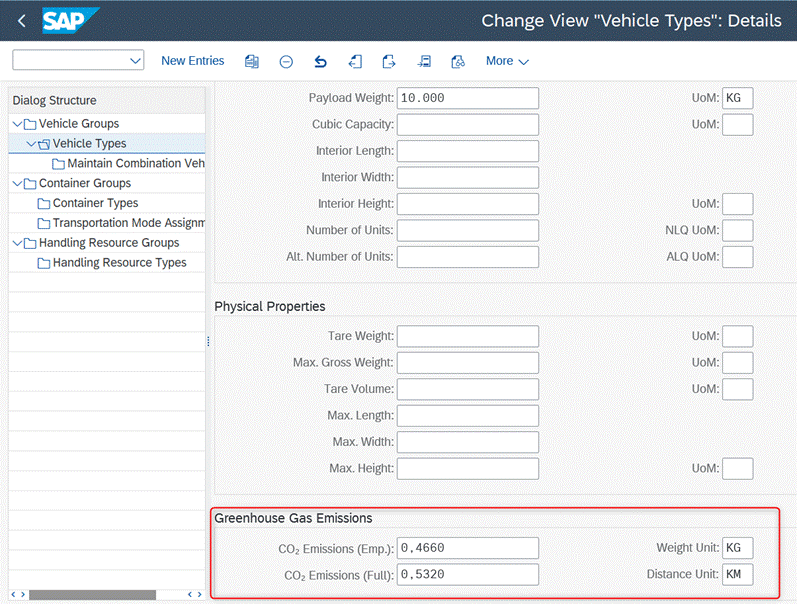
However, even for shippers, it is still possible to define average vehicle characteristics based on truck category and generation, allowing the system to produce reliable estimations.
It should also be noted that, although not mandatory, using actual transport distances further improves the quality of the emissions estimate.
Dynamic Calculation:
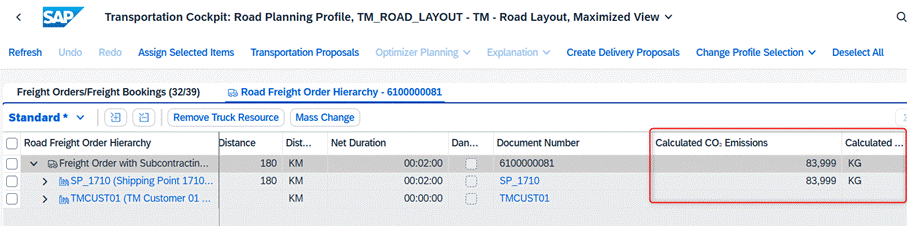
CO₂ emissions generated by a transport are calculated as soon as a transportation requirement is planned within a Freight Order.
The results are directly visible in the Transportation Cockpit and can be used as decision criteria when comparing different planning scenarios.
These values are also available in a dedicated tab within the Freight Order, allowing users to analyze emissions per transportation stage.
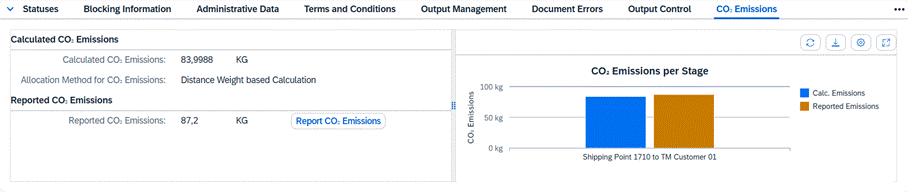
A dedicated function also allows users to import emissions data provided by a transport service provider. This capability enables companies to compare estimated values with actual emissions data, and to refine future planning calculations.
Emissions data can also be reported via API. In this case, the information is transmitted using the API designed to record an event on a specific transportation stage.
The emissions information is also replicated into the corresponding Freight Units, ensuring that the data remains available across all transport-related documents.
Reporting:
Since the emissions data is stored within the relevant transportation documents, it can be used to build KPIs and analytical reports.
However, to benefit from comprehensive and precise sustainability reporting, integration with SAP Sustainability Footprint Management (SFM) must be activated.
Beyond being a simple operational indicator, emissions calculation is increasingly becoming a key lever for regulatory compliance and strategic decision-making, particularly in the context of CSRD requirements and Scope 3 reporting. This is only possible if emissions data is properly structured and leveraged within SAP TM and the associated reporting and consolidation tools.