

Context
Operating in 80 countries with more than 161,000 employees and close to 1,100 industrial sites, Saint-Gobain is one of the world’s leading construction materials groups. Committed to sustainable construction, energy-efficient renovation and the decarbonization of industry, the Group relies on complex and highly diverse logistics operations to support its global footprint.
The modernization of the SAP landscape, combined with the upcoming transition to SAP S/4HANA, highlighted the limitations of existing warehouse management solutions. Aging WMS platforms, heterogeneous processes across sites, complex integrations and limited ergonomics for warehouse operators made it increasingly difficult to support performance, scalability and automation. With more than fifty logistics sites to address across EMEA, Saint-Gobain initiated a transformation program designed to standardize warehouse execution while ensuring operational continuity.
Project challenges
The program had to address several challenges simultaneously. Saint-Gobain needed to replace an outdated WMS while maintaining ongoing operations, manage the coexistence of SAP ECC and SAP S/4HANA, and design a standardized yet flexible model capable of supporting very different warehouse profiles. Integration was another critical dimension, as the future solution needed to connect seamlessly with production systems, quality management, transport solutions and an increasing number of automated technologies.
The shop floor experience was also a key concern. While SAP RF transactions were already in use, they showed clear limitations in terms of usability, scanning performance and resilience to network disruptions. Saint-Gobain was therefore looking for a modern mobility solution that could fully support SAP EWM while significantly improving user adoption and operational efficiency.
The solution
Saint-Gobain entrusted HRC Consulting with the design and deployment of an EMEA SAP EWM Core Model. Two Core Models were defined to reflect the specific activities and processes of the Group’s different Business Units. The selected architecture is based on decentralized SAP EWM, connected to multiple SAP ERP systems (ECC today and S/4HANA in the future) ensuring both continuity of service and long-term scalability.
To accommodate the diversity of warehouse operations across EMEA, the Core Model is built around a t-shirt size approach. Each site is assessed according to its operational complexity (volumes, process sophistication, level of automation) and assigned an appropriate EWM “size,” ranging from simple to advanced. This modular approach enables Saint-Gobain to maximize standardization while avoiding unnecessary complexity, and to accelerate deployments without multiplying site-specific developments.
Initial pilot sites in Germany, Spain and Romania played a key role in validating the model, stabilizing processes and preparing the industrial rollout. The program is supported by a central EWM team responsible for governance and Core Model integrity, as well as dedicated flying teams operating locally to deploy the solution and support sites during go-live.
The mobile solution from HRC Software, at the heart of shop floor transformation
To fully leverage SAP EWM on the shop floor, Saint-Gobain conducted an in-depth evaluation of available mobility options, including standard RF transactions, off-the-shelf market solutions and custom developments. While RF transactions offered functional coverage, their limitations in usability and performance quickly highlighted the need for a more modern alternative.
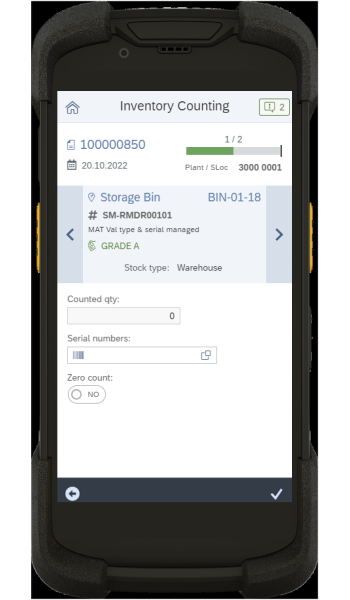
The mobile solution developed by HRC Software was selected for its ability to combine ergonomic design, rapid deployment and native SAP integration. Based on SAP EWM and SAP MM/IM standards, the solution requires no additional infrastructure and can be deployed in less than 24 hours on the existing SAP system. Designed specifically for industrial devices, its intuitive interface simplifies task execution, resource management, inventory operations and task progress tracking.
By improving usability and reducing cognitive load for operators, the solution accelerates adoption, improves data quality and provides real-time visibility into warehouse activities: key success factors in a transformation program of this scale.
Structured governance and deployment organization
The program is jointly governed by Saint-Gobain’s GDI teams and HRC Consulting, following a structured and industrialized methodology. A central EWM competence center ensures consistency of the Core Model, manages change and data governance, and arbitrates functional evolutions. At the same time, flying teams (composed of EWM specialists and local resources) support deployments on site, enabling parallel rollouts while maintaining overall coherence.
This organization also supports the gradual transfer of knowledge to Saint-Gobain’s internal teams, allowing the Group to progressively internalize EWM expertise and scale deployments more efficiently over time.
Results and outlook
The first deployments confirm the robustness of the approach. Warehouse operations have become more fluid, visibility on stock and flows has improved, and traceability has been reinforced across processes. On the shop floor, the mobile solution from HRC Software significantly enhances the operator experience and supports faster and more sustainable adoption of SAP EWM.
With a standardized, modular and scalable SAP EWM framework now in place, Saint-Gobain has laid the foundations for a long-term logistics transformation. The program supports the S/4HANA transition, prepares warehouses for increasing levels of automation, and enables the Group to roll out a consistent execution model across EMEA while respecting local operational realities.